
Desirous Meaning: Definition, Examples and How to Use It Correctly
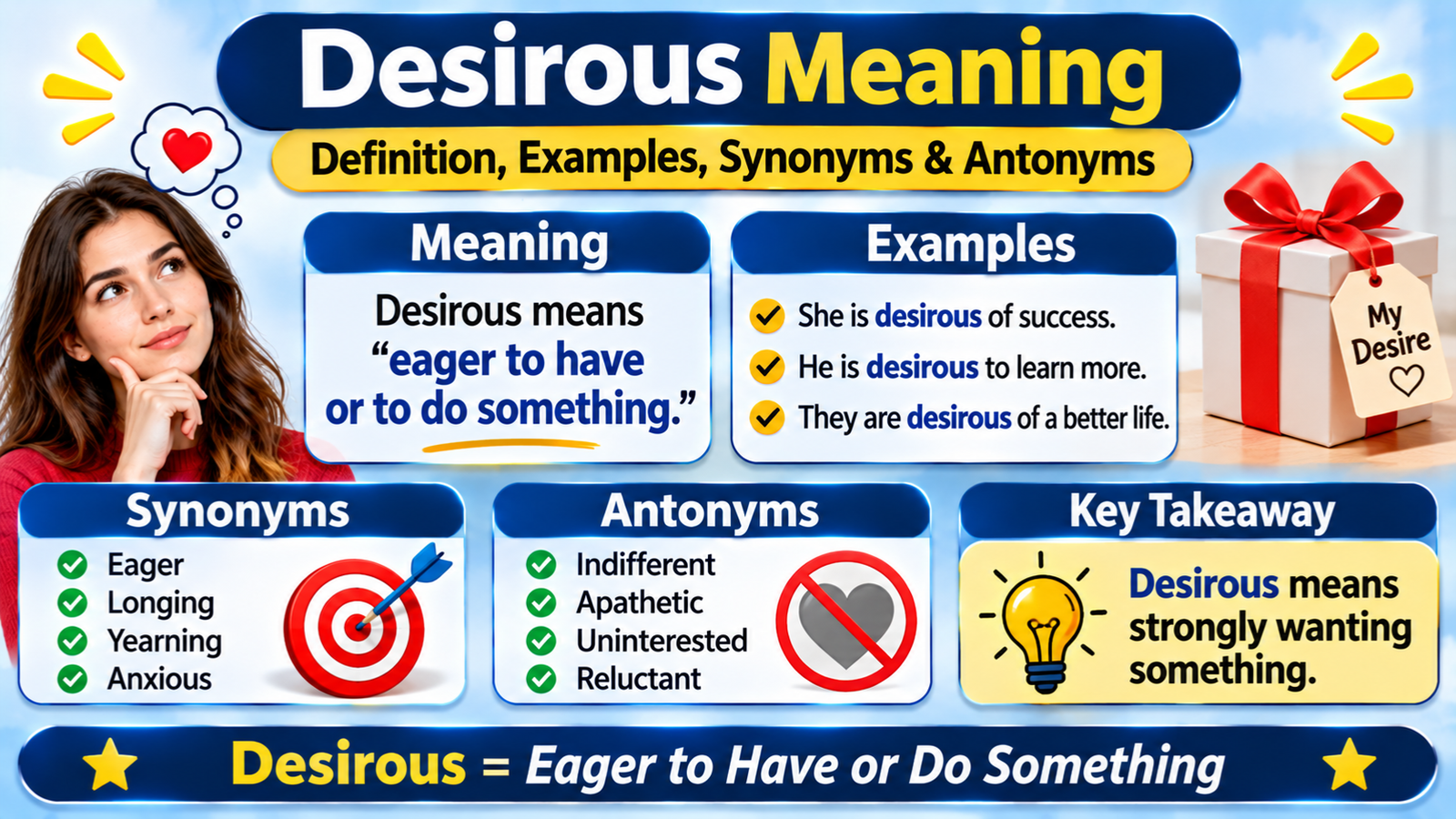
Desirous means having or showing a strong wish for something. It is an adjective, and it almost always appears in the pattern “desirous of” something: She was desirous of a quieter life. It is a formal word, so you will meet it more often in essays, speeches, legal writing and novels than in everyday chat.
That is the quick version of the desirous meaning. The rest of this guide covers the grammar rule that trips most learners up, fifteen example sentences, pronunciation, where the word comes from, its synonyms and opposites, and how it differs from desirable and desiring, the look-alikes behind most of the mistakes. There is also a short practice quiz at the end.
Desirous Meaning: The Quick Answer
If someone is desirous, they want something, and they want it with some force. It is stronger than “interested” and close to “eager” or “keen,” but it carries a formal, slightly old-fashioned tone.
A simple way to remember it: desirous = full of desire. The ending -ous means “full of,” the same as in joyous (full of joy), famous (full of fame) and anxious (full of anxiety). Take the ending away and you are left with desire.
Desirous Definition and Part of Speech
The desirous meaning in dictionaries is short and consistent. Dictionaries such as Merriam-Webster, Oxford and Dictionary.com list desirous as an adjective meaning “having or expressing a wish or desire” for something. The core ideas they use are “wishful” and “eager.”
Grammar teachers call it a predicate adjective. That means it usually comes after a verb like be, feel, become or seem, instead of sitting directly in front of a noun. You say “He was desirous of change.” You rarely say “a desirous man,” and if you did, many readers would hear a different, more physical sense, which is why the word is safest in the “be desirous of” pattern.
Related forms:
- Desire is both the noun (a strong feeling of wanting) and a formal verb (to want strongly).
- Desirous is the adjective for the person who wants.
- Desirable is the adjective for the thing worth wanting.
- Desiring is the present participle of the verb.
- Desirously is the rare adverb: She looked desirously at the cake.
- Desirousness is the rare noun. Most writers use desire instead.
How to Use Desirous in a Sentence
Here is the plain version of the grammar, in three patterns.
Desirous of + noun
This is the standard pattern and the one to learn first. Whatever follows “of” is the thing the person wants.
- She was desirous of success.
- The company was desirous of expansion.
- The child was desirous of attention.
Desirous of + -ing verb
When the wish is for an action, put the verb in its -ing form after “of.”
- They were desirous of finding a peaceful solution.
- He was desirous of learning more about the subject.
Desirous to + verb
This pattern exists too. Oxford records “desirous to do something” as one of its grammatical patterns, and you will find it in older books: He was desirous to meet the king. It is less common in modern writing than “desirous of doing,” so it is safer to default to “of” unless you are copying the voice of an older text.
Desirous of or desirous for?
“Desirous of” is the standard form. “Desirous for” is not a recognized pattern, so if you wrote “desirous for success,” change it to “desirous of success.”
If a sentence still sounds stiff after you have used the right pattern, the problem may be the word itself. Try eager to, keen to or plain wanted.
Desirous Example Sentences

Seeing the desirous meaning in action is the fastest way to learn it. Here are fifteen examples from different settings, so you can see the range of the word.
- School. The students were desirous of a longer break before exams.
- Work. The new manager was desirous of earning the team’s trust quickly.
- Business. The company, desirous of expanding abroad, hired a local adviser.
- Family. My grandmother was always desirous of seeing her relatives gather for the holidays.
- Travel. Desirous of a quiet week, we booked a cabin far from the city.
- Politics. The council, desirous of public support, published the full report.
- Literature. The hero, desirous of revenge, set out at dawn.
- Law and contracts. Any party desirous of ending the agreement must give thirty days’ written notice.
- Romance. She felt desirous of his company, though she would never have said so.
- Personal growth. He grew desirous of a life with more meaning than money.
- Science. The researchers, desirous of understanding the cause, repeated the experiment.
- Community. Residents desirous of a new park gathered signatures.
- Sports. The young goalkeeper was desirous of a place in the national squad.
- Careers. She became desirous of a role that used her languages.
- History. The king, desirous of peace with his neighbors, sent gifts across the border.
Look at the pattern. In almost every one the word comes after the subject or right after a comma, and “of” follows it.
How to Pronounce Desirous
The word has three syllables, with the stress on the middle one: dih-ZY-rus. In American English it sounds close to /dɪˈzaɪrəs/, and some dictionaries show the first vowel as a lighter schwa (/dəˈzaɪrəs/). In British English the middle part is often a little longer, closer to “dih-ZY-uh-rus.”
The common slip is stressing the first syllable. If you can say desire (dih-ZYER), you already have the hard part, because desirous is built on the same sound. Written out syllable by syllable it is de-si-rous, but in speech the last two parts blur together.
Origin and Etymology
The history of the desirous meaning starts in French. Desirous entered Middle English around the year 1300, and Etymonline traces it through Anglo-French and Old French (desirous, today désireux) to Vulgar Latin desiderosus, which comes from the Latin verb desiderare, “to long for” or “to wish for.” That verb is also the root of desire.
There is a famous but uncertain detail deeper in the family tree. Some sources link desiderare to Latin sidus, “star,” which would mean something like “to wait for what the stars bring.” That explanation is debated, so treat it as an interesting theory instead of settled fact.
The meaning has barely moved over the centuries. It was a word about wanting then, and it still is. What changed is the tone. It used to sit comfortably in ordinary speech, and now it reads as formal.
Desirous Synonyms
No single synonym covers every use, so it helps to group them by the kind of wanting involved.
Wanting something specific: wishful, wanting, hopeful, interested in. Wishful is the nearest everyday match.
Eager to do something: eager, keen, avid, enthusiastic. These work best when the thing you want is an action.
Longing for something out of reach: longing, yearning, craving, hungry. These add emotion and distance.
Aiming at a goal: aspiring, seeking, intent on. These point at ambition rather than feeling.
Wanting what belongs to others: covetous, greedy, grasping. These carry a negative judgment that desirous does not.
Compare two sentences. “She was keen to join the team” is relaxed and natural. “She was desirous of joining the team” is more formal and stiffer. Same idea, different temperature.
Desirous Antonyms
The opposite of the desirous meaning is a lack of wanting, and the right word depends on why the wanting is missing:
- Indifferent and uninterested, when there is no feeling either way
- Unwilling and reluctant, when the person is pushed toward something they do not want
- Disinclined, when they would rather not
- Averse, when they actively dislike the idea
- Content, when they already have what they need
She was reluctant to accept the offer and he was indifferent to the outcome are both opposites of desirous, but they describe very different states of mind.
Desirous vs Desirable (and Other Confusing Words)

These two look almost identical and mean different things. The difference is who is doing the wanting.
| Word | What it describes | Example |
| Desirous | The person who wants something | She was desirous of a promotion. |
| Desirable | The thing that is worth wanting | A promotion is a desirable goal. |
| Eager | A person looking forward to something, usually an action | She was eager to start. |
The desirous meaning points at the person, and that gives you a trick that works well: if the word describes the person with the wish, use desirous. If it describes the thing people wish for, use desirable. A house can be desirable. The buyer is desirous of it.
Desirous vs desiring
Desiring is the -ing form of the verb desire, so it behaves like a verb. Desirous is a true adjective. “She was desirous of success” sounds formal but natural. “She was desiring success” is grammatically possible but sounds unusual, and most speakers would just say “She wanted success.”
There is a handy style ladder for this family: want → desire → be desirous of. The meaning stays related while the tone climbs from casual to very formal.
Desirous vs desired and desperate
Desired simply means “wanted” and works as a verb form or modifier (the desired result). Desperate implies urgency or a lack of options, which desirous does not. A person can be desirous without being desperate.
Is Desirous a Positive or Negative Word?
Desirous is neutral, and so is its meaning. It says that someone wants something and says nothing about whether the wanting is good or bad. The object of the desire carries the judgment.
She was desirous of knowledge sounds positive. He was desirous of wealth is neutral. The ruler was desirous of absolute power sounds worrying. In each case the adjective does the same job, and the thing wanted changes how we feel about the sentence.
Common Mistakes With Desirous
Most errors come from guessing the desirous meaning from the sound of the word. These are the usual ones.
Using “desirous” for things instead of people. Wrong: “The desirous location attracted buyers.” Right: “The desirable location attracted buyers.”
Dropping “of.” Wrong: “She is desirous success.” Right: “She is desirous of success.”
Using “for” instead of “of.” Wrong: “He is desirous for change.” Right: “He is desirous of change.”
Reaching for it in casual speech. “I’m desirous of pizza” works as a joke, and as sincere speech it sounds odd. In a text to a friend, “I really want pizza” does the job.
Mixing up the stress. Remember dih-ZY-rus, with the weight on the middle.
Desirous in Formal vs Everyday English
Here is my honest take. Desirous is a perfectly good word that belongs in a limited number of places.
The desirous meaning suits formal writing best. Use it in essays, cover letters, speeches, contracts, official notices and fiction with a period feel. In those settings it gives a sentence weight and polish. “Any applicant desirous of an extension should write to the registrar” sounds exactly right in an official notice. Some dictionaries label the word “formal,” and at least one marks it “old-fashioned formal,” which fits what you will see in real writing.
Skip it in conversation, social media posts, emails to colleagues and anything meant to sound warm and quick. Even though the desirous meaning is easy to grasp, the word can make a speaker sound stiff. There, “want,” “keen” and “eager” are friendlier. A good test is to read your sentence aloud. If it sounds like you are giving a speech, either the setting calls for desirous or you should pick a simpler word.
Here is the same idea at three levels of formality:
- Casual: I want to learn more about photography.
- Professional: I am eager to learn more about photography.
- Formal: I am desirous of learning more about photography.
All three mean the same thing. They just sound like three different writers.
Desirous for IELTS, TOEFL and CSS English
If you are preparing for an exam like IELTS, TOEFL or CSS English, the desirous meaning is worth learning because it is a useful word for formal essays and letters. Use it once or twice, in the “desirous of” pattern, instead of in every paragraph. Examiners notice natural use of formal vocabulary. They also notice a sentence that has been forced to fit a fancy word.
Desirous vs Eager vs Longing
These three overlap, but each has its own flavor.
Eager adds enthusiasm or impatience: The children were eager to open their presents. Saying “desirous of opening their presents” would sound oddly formal.
Longing adds emotion and often distance: He was longing to return home suggests he misses it. He was desirous of returning home says only that he wants to go back.
Desirous sits in the middle: a clear, formal statement of wanting, without the excitement of eager or the ache of longing.
Quick Practice
Fill in the blanks with desirous, desirable, eager or desiring. The answers follow.
- The company is ______ of hiring more engineers this year.
- A quiet neighborhood is a ______ feature for most families.
- The children were ______ to open their presents.
- Any student ______ of a scholarship must apply by Friday.
- Fix the mistake: “She was desirous for a promotion.”
- Fix the mistake: “The desirous apartment had a great view.”
Answers: 1. desirous. 2. desirable. 3. eager (the pattern is “eager to” plus a verb). 4. desirous. 5. “desirous of a promotion.” 6. “The desirable apartment had a great view.”
FAQs About the Desirous Meaning
These are the questions people ask most often when they look up the desirous meaning.
What does desirous mean?
Desirous means having a strong wish for something. It is a formal adjective, usually followed by “of,” as in “desirous of success.”
What is the simple meaning of desirous?
The simplest version is “wanting.” You can remember it as: desirous = full of desire.
What is the meaning of “desirous of”?
“Desirous of” means “wanting” or “wishing for.” Whatever comes after “of” is the thing the person wants: desirous of peace, desirous of a change, desirous of learning.
Is it “desirous of” or “desirous to”?
Use “desirous of.” It is the standard pattern in modern English, followed by a noun or an -ing verb. “Desirous to” plus a verb does appear in dictionaries and in older writing, but it is less common today.
Is it “desirous of” or “desirous for”?
It is “desirous of.” “Desirous for” is not a standard pattern.
What is the difference between desirous and desirable?
Desirous describes the person who wants something. Desirable describes the thing that is worth wanting. A buyer is desirous of a house, and the house is desirable.
What part of speech is desirous?
It is an adjective. It normally follows a verb such as “be” or “feel,” so it acts as a predicate adjective, as in “He was desirous of change.”
What is a synonym for desirous?
Common synonyms are wishful, eager, keen, avid, longing and yearning. “Eager” and “keen” work for actions, while “longing” suits something out of reach.
What is the opposite of desirous?
It depends on the situation. Indifferent, uninterested, reluctant, unwilling and averse are all opposites, but each describes a different reason for not wanting something.
Is desirous a formal word?
Yes. You will see it in formal writing, official notices and literature. In everyday conversation people usually say “want,” “keen” or “eager” instead.
Can desirous describe a bad desire?
Yes. The word is neutral. “He was desirous of revenge” describes what he wanted, and the negative feeling comes from revenge, not from the adjective.
How do you pronounce desirous?
Say dih-ZY-rus, with the stress on the second syllable. The British version has a slightly longer middle sound, but the stress stays in the same place.
What is the adverb form of desirous?
The adverb is desirously, as in “He looked desirously at the trophy.” It is rare, so most writers choose a different phrase.
Where does the word desirous come from?
It reached English around 1300 from Old French and goes back through Vulgar Latin to desiderare, “to long for.” That is also the root of the word desire.
Final Thought
The desirous meaning comes down to this: full of desire. The one rule worth memorizing is “desirous of.” Use it for people, never for things (that is what desirable is for), and keep it for formal writing. In a casual message, pick eager or keen and move on.





One Comment